

WATERMELON v3 MOBILE APP
WATERMELON v3 MOBILE APP
WATERMELON v3 MOBILE APP
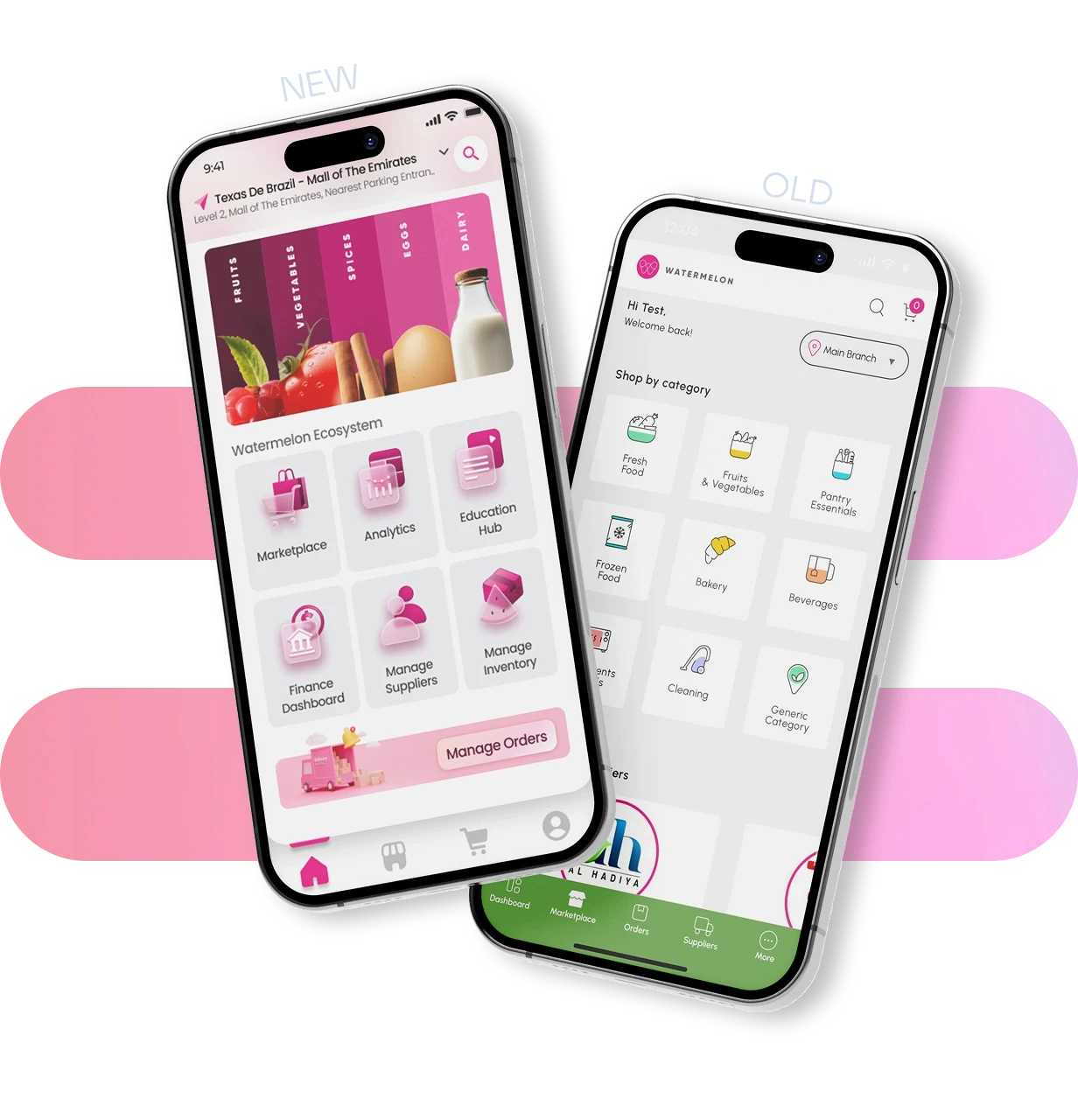
Designed and led the evolution from MVP to a scalable product ecosystem, transforming low-adoption MVP workflows into a high-performing product that significantly increased in app discoverability, user adoption, and operational efficiency.
Designed and led the evolution from MVP to a scalable product ecosystem, transforming low-adoption MVP workflows into a high-performing product that significantly increased in app discoverability, user adoption, and operational efficiency.
Designed and led the evolution from MVP to a scalable product ecosystem, transforming low-adoption MVP workflows into a high-performing product that significantly increased in app discoverability, user adoption, and operational efficiency.
Designed and led the evolution from MVP to a scalable product ecosystem, transforming low-adoption MVP workflows into a high-performing product that significantly increased in app discoverability, user adoption, and operational efficiency.
4 Connected Platforms
4 Connected Platforms
4 Connected Platforms
Buyers, Suppliers, POS, Back-End Admin
Buyers, Suppliers, POS, Back-End Admin
Buyers, Suppliers, POS, Back-End Admin
Buyers, Suppliers, POS, Back-End Admin
2900+
2900+
2900+
Restaurants
Restaurants
Restaurants
Restaurants
750+
750+
750+
Suppliers
Suppliers
Suppliers
Suppliers
30,000+
30,000+
30,000+
SKUs
SKUs
SKUs
SKUs
10X
10X
10X
GMV Growth in 2 Years
GMV Growth in 2 Years
GMV Growth in 2 Years
GMV Growth in 2 Years
OVERVIEW
OVERVIEW
OVERVIEW
OVERVIEW
From MVP to MVP
From MVP to MVP
From MVP to MVP
From MVP to MVP

A glow-up that made all stakeholders cry:
UI Refresh & Improved Navigation
Enhanced Supplier Discoverability
4X Increased App Session Length
24% Increased Avg Ticket Value
40% reduced manual admin work
Faster User Sign-up and Account Set-up
New Supplier Catalogs | Unified Payments | Credit Finance | Dynamic Cart | User Tier Hierarchy | Quick Check-out ....
A glow-up that made all stakeholders cry:
UI Refresh & Improved Navigation
Enhanced Supplier Discoverability
4X Increased App Session Length
24% Increased Avg Ticket Value
40% reduced manual admin work
Faster User Sign-up and Account Set-up
New Supplier Catalogs | Unified Payments | Credit Finance | Dynamic Cart | User Tier Hierarchy | Quick Check-out ....
Step 1
Step 1
Step 1
Step 1
Framing the
Problem
Framing the
Problem
Framing the
Problem
Framing the Problem
Understanding why the product wasn’t being used.
Understanding why the product wasn’t being used.
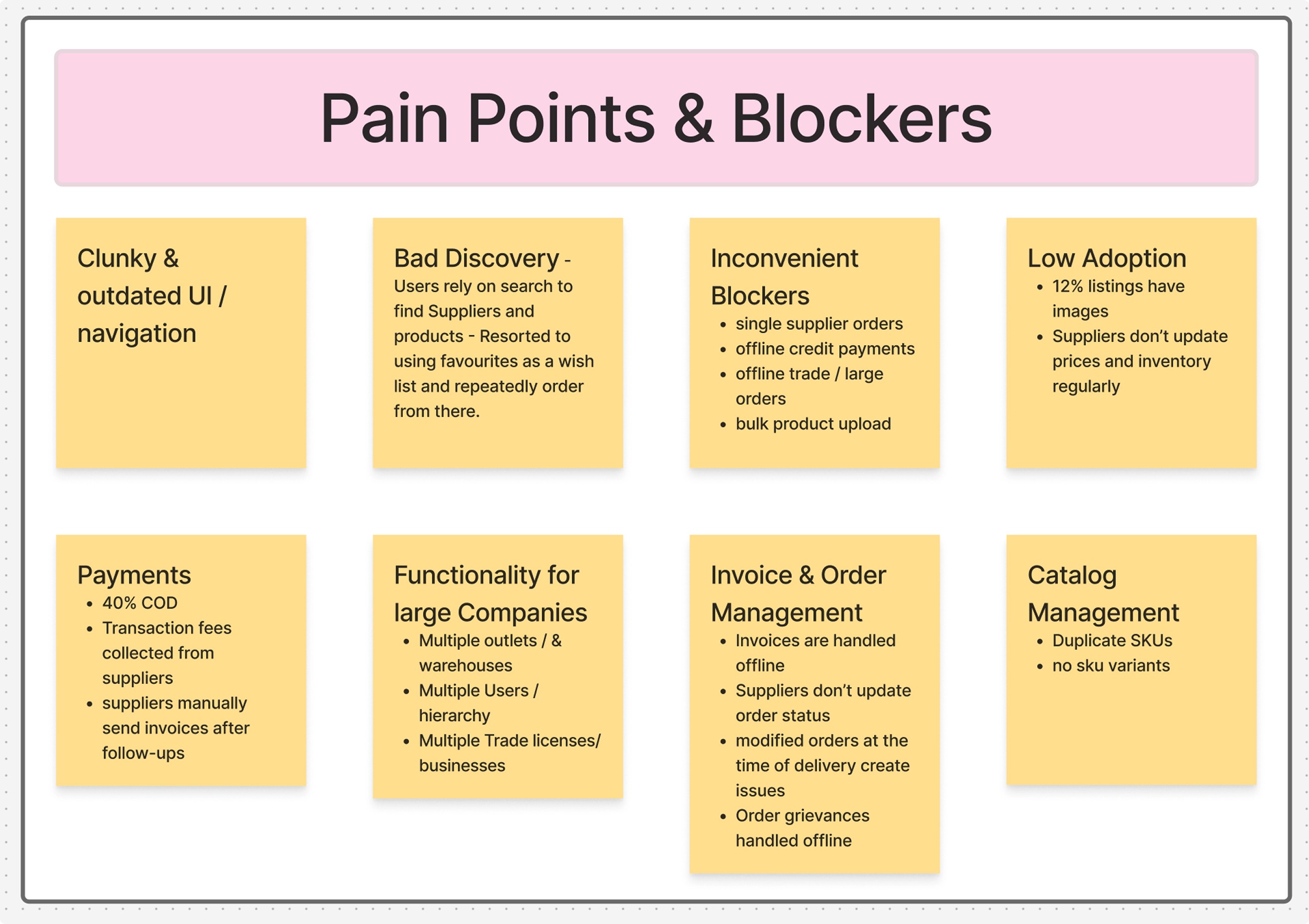
Before redesigning screens, we needed to understand why a product built to simplify procurement was being actively avoided.
Through user interviews, operational audits, and live order shadowing, we uncovered a pattern: most high-value workflows were happening outside the app. Orders, payments, invoices, and credit were all being managed manually — turning the platform into an incomplete catalogue, not a system.
Before redesigning screens, we needed to understand why a product built to simplify procurement was being actively avoided.
Through user interviews, operational audits, and live order shadowing, we uncovered a pattern: most high-value workflows were happening outside the app. Orders, payments, invoices, and credit were all being managed manually — turning the platform into an incomplete catalogue, not a system.
Before redesigning screens, we needed to understand why a product built to simplify procurement was being actively avoided.
Through user interviews, operational audits, and live order shadowing, we uncovered a pattern: most high-value workflows were happening outside the app. Orders, payments, invoices, and credit were all being managed manually — turning the platform into an incomplete catalogue, not a system.
Before redesigning screens, we needed to understand why a product built to simplify procurement was being actively avoided.
Through user interviews, operational audits, and live order shadowing, we uncovered a pattern: most high-value workflows were happening outside the app. Orders, payments, invoices, and credit were all being managed manually — turning the platform into an incomplete catalogue, not a system.
Key themes surfaced:
Discovery was poor, pricing was opaque, and supplier reliability was unclear
Large and credit-based orders bypassed the platform entirely
Discovery was poor, pricing was opaque, and supplier reliability was unclear
Large and credit-based orders bypassed the platform entirely
Suppliers lacked motivation and tools to maintain listings
Operational complexity increased after checkout, not before
Suppliers lacked motivation and tools to maintain listings
Operational complexity increased after checkout, not before
Suppliers lacked motivation and tools to maintain listings
Operational complexity increased after checkout, not before
Suppliers lacked motivation and tools to maintain listings
Operational complexity increased after checkout, not before
Step 2
Step 2
Step 2
Step 2
Benchmarks &
Inspiration
Benchmarks & Inspiration
Benchmarks &
Inspiration
Framing the Problem
Learning from leaders of industry
- not direct competition.
Learning from leaders of industry
- not direct competition.
Learning from leaders of industry
- not direct competition.
Learning from leaders of industry
- not direct competition.
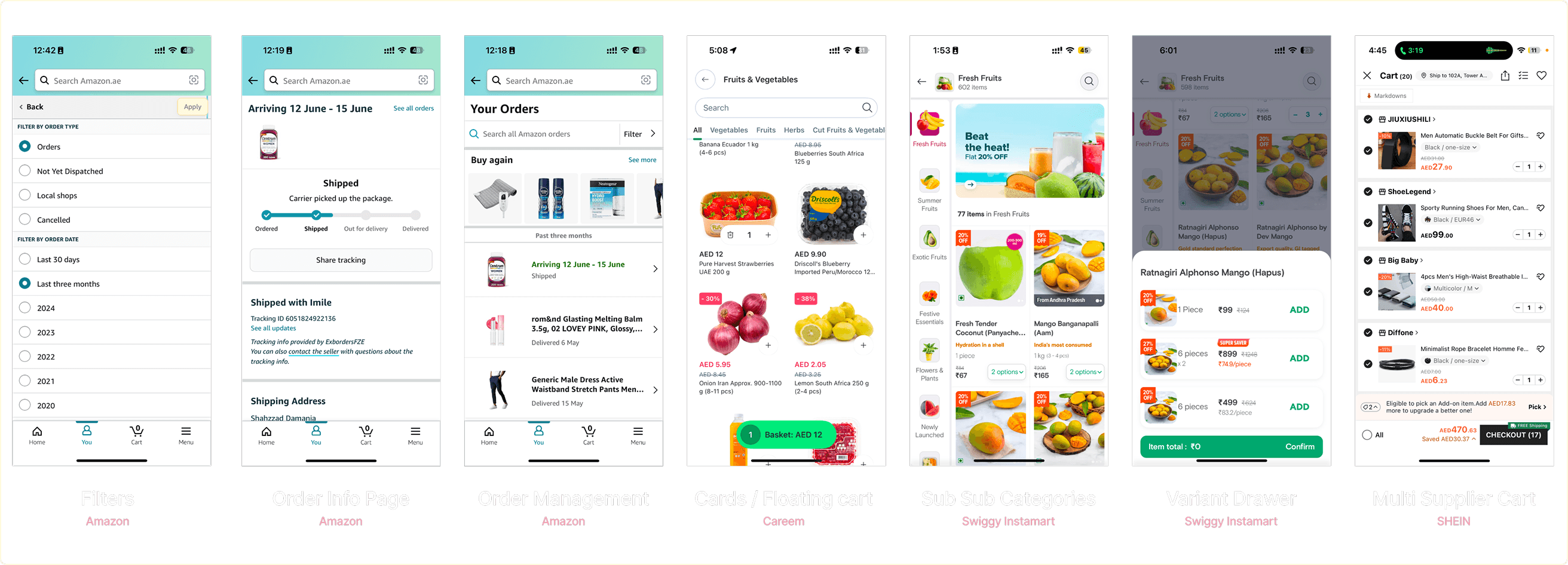
We studied B2C leaders to understand:
How trust is communicated
How discovery is accelerated
How complexity is hidden behind simplicity
We studied B2C leaders to understand:
How trust is communicated
How discovery is accelerated
How complexity is hidden behind simplicity
We studied B2C leaders to understand:
How trust is communicated
How discovery is accelerated
How complexity is hidden behind simplicity
We studied B2C leaders to understand:
How trust is communicated
How discovery is accelerated
How complexity is hidden behind simplicity
References included Amazon, Careem, Carrefour, Swiggy Instamart, Tabby and SHEIN — not to mimic UI, but to extract patterns of behaviour, interaction, and expectation.
References included Amazon, Careem, Carrefour, Swiggy Instamart, Tabby and SHEIN — not to mimic UI, but to extract patterns of behaviour, interaction, and expectation.
References included Amazon, Careem, Carrefour, Swiggy Instamart, Tabby and SHEIN — not to mimic UI, but to extract patterns of behaviour, interaction, and expectation.
References included Amazon, Careem, Carrefour, Swiggy Instamart, Tabby and SHEIN — not to mimic UI, but to extract patterns of behaviour, interaction, and expectation.
Step 3
Step 3
Step 3
Step 3
Rebuilding
Discovery as a
Growth Lever
Rebuilding Discovery as a Growth Lever
Rebuilding
Discovery as a
Growth Lever
Framing the Problem
Making the marketplace worth browsing —
not just ordering.
Making the marketplace worth browsing — not just ordering.
Making the marketplace worth browsing —
not just ordering.
Making the marketplace worth browsing —
not just ordering.
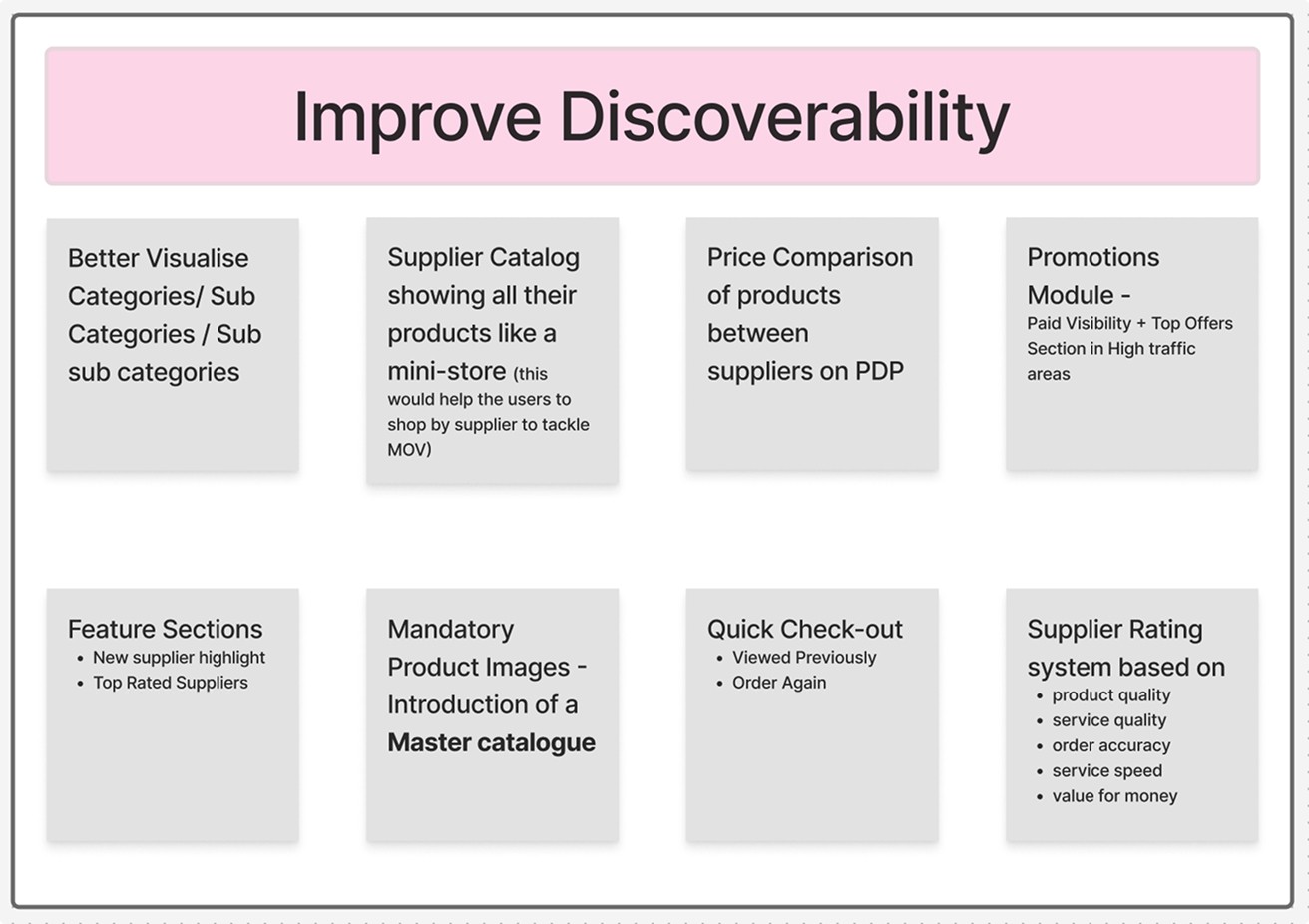
Once the core blockers were mapped, we focused on the highest-leverage opportunity: improving how buyers discover products, suppliers, and value.
Discovery wasn’t just about search — it was about confidence, comparison, and clarity.
Once the core blockers were mapped, we focused on the highest-leverage opportunity: improving how buyers discover products, suppliers, and value.
Discovery wasn’t just about search — it was about confidence, comparison, and clarity.
Once the core blockers were mapped, we focused on the highest-leverage opportunity: improving how buyers discover products, suppliers, and value.
Discovery wasn’t just about search — it was about confidence, comparison, and clarity.
Once the core blockers were mapped, we focused on the highest-leverage opportunity: improving how buyers discover products, suppliers, and value.
Discovery wasn’t just about search — it was about confidence, comparison, and clarity.
This phase explored how users want to shop in a B2B context:
This phase explored how users want to shop in a B2B context:
By category when they’re exploring
By supplier when they’re optimising for MOV
By category when they’re exploring
By supplier when they’re optimising for MOV
By price when margins matter
By trust signals when stakes are high
By price when margins matter
By trust signals when stakes are high
Step 4
Step 4
Step 4
Step 4
Reimagining
payments &
Operational flows
Reimagining payments & Operational flows
Reimagining
payments &
Operational flows
Framing the Problem
Bringing money, trust, and accountability back into the platform.
Making the marketplace worth browsing — not just ordering.
Bringing money, trust, and accountability back into the platform.
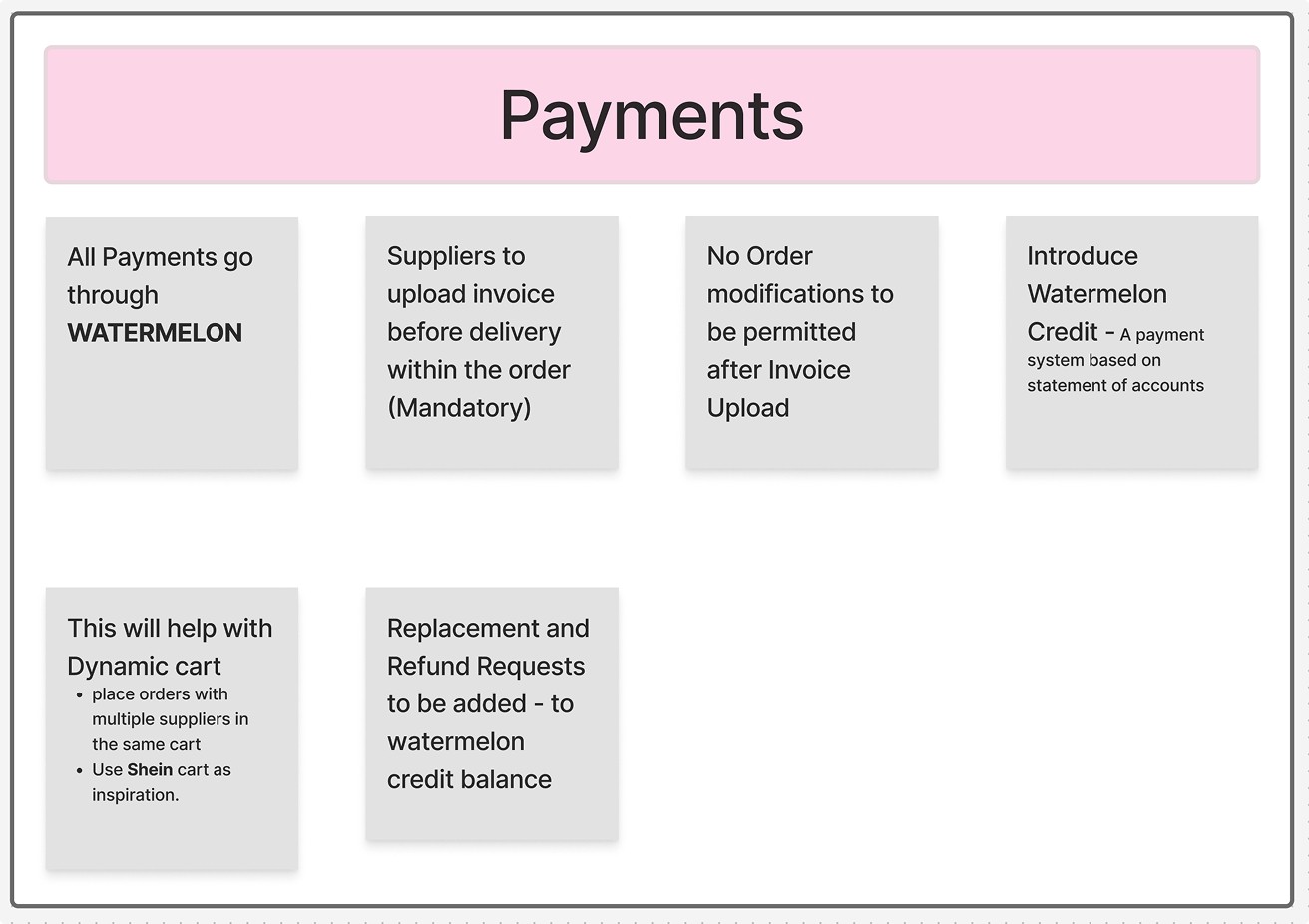
Lack of unified payments were the single biggest blocker for user adoption.
Cash on delivery, offline invoices, manual credit approvals, and post-order chaos meant Watermelon had no real control over its own transactions. This section shows how we redesigned payments not as a feature — but as an operating system.
Lack of unified payments were the single biggest blocker for user adoption.
Cash on delivery, offline invoices, manual credit approvals, and post-order chaos meant Watermelon had no real control over its own transactions. This section shows how we redesigned payments not as a feature — but as an operating system.
Lack of unified payments were the single biggest blocker for user adoption.
Cash on delivery, offline invoices, manual credit approvals, and post-order chaos meant Watermelon had no real control over its own transactions. This section shows how we redesigned payments not as a feature — but as an operating system.
Lack of unified payments were the single biggest blocker for user adoption.
Cash on delivery, offline invoices, manual credit approvals, and post-order chaos meant Watermelon had no real control over its own transactions. This section shows how we redesigned payments not as a feature — but as an operating system.
Key shifts included:
Centralising all payments through Watermelon
Enabling multi-supplier carts inspired by SHEIN
Introducing Watermelon Credit with statements, limits, and dynamic pricing logic
Centralising all payments through Watermelon
Enabling multi-supplier carts inspired by SHEIN
Introducing Watermelon Credit with statements, limits, and dynamic pricing logic
Enforcing invoice uploads before delivery
Designing refunds and replacements as credit flows, not exceptions
Enforcing invoice uploads before delivery
Designing refunds and replacements as credit flows, not exceptions
Enforcing invoice uploads before delivery
Designing refunds and replacements as credit flows, not exceptions
Step 5
Step 5
Step 5
Step 5
Mapping Transaction Types & Flows
Mapping Transaction Types & Flows
Mapping Transaction Types & Flows
Framing the Problem
Not all orders are equal — and the platform had to reflect that.
Making the marketplace worth browsing — not just ordering.
Not all orders are equal — and the platform had to reflect that.
This flow diagram visualises:
Cash vs prepaid vs credit transactions
Single supplier vs multi-supplier orders
Cash vs prepaid vs credit transactions
Single supplier vs multi-supplier orders
Partial availability and split fulfilment
Refunds, replacements, and adjustments
Partial availability and split fulfilment
Refunds, replacements, and adjustments
By mapping every transaction path early, we ensured the UI could scale without breaking under edge cases.
By mapping every transaction path early, we ensured the UI could scale without breaking under edge cases.

Step 6
Step 6
Step 6
Step 6
Early testing & Trials
Early testing &Trials
Early testing & Trials
Framing the Problem
Exploration before execution.
Making the marketplace worth browsing — not just ordering.
Exploration before execution.
With the structural foundations in place, we explored multiple early look-and-feel directions to pressure-test how the product should feel before committing to a final system.
With the structural foundations in place, we explored multiple early look-and-feel directions to pressure-test how the product should feel before committing to a final system.
With the structural foundations in place, we explored multiple early look-and-feel directions to pressure-test how the product should feel before committing to a final system.
These initial visual explorations were intentionally broad — designed to test:
These initial visual explorations were intentionally broad — designed to test:
These initial visual explorations were intentionally broad — designed to test:
Speed and clarity for high-frequency, daily
buyers
Depth, control, and confidence for power users
Speed and clarity for high-frequency, daily
buyers
Depth, control, and confidence for power users
Levels of visual warmth vs. operational seriousness
How trust, scale, and reliability could be communicated visually
Levels of visual warmth vs. operational seriousness
How trust, scale, and reliability could be communicated visually
Although these explorations didn’t ship, they were instrumental in defining the visual principles, hierarchy, and tone that ultimately shaped the scalable design system shown in the final screens.
Although these explorations didn’t ship, they were instrumental in defining the visual principles, hierarchy, and tone that ultimately shaped the scalable design system shown in the final screens.
Although these explorations didn’t ship, they were instrumental in defining the visual principles, hierarchy, and tone that ultimately shaped the scalable design system shown in the final screens.
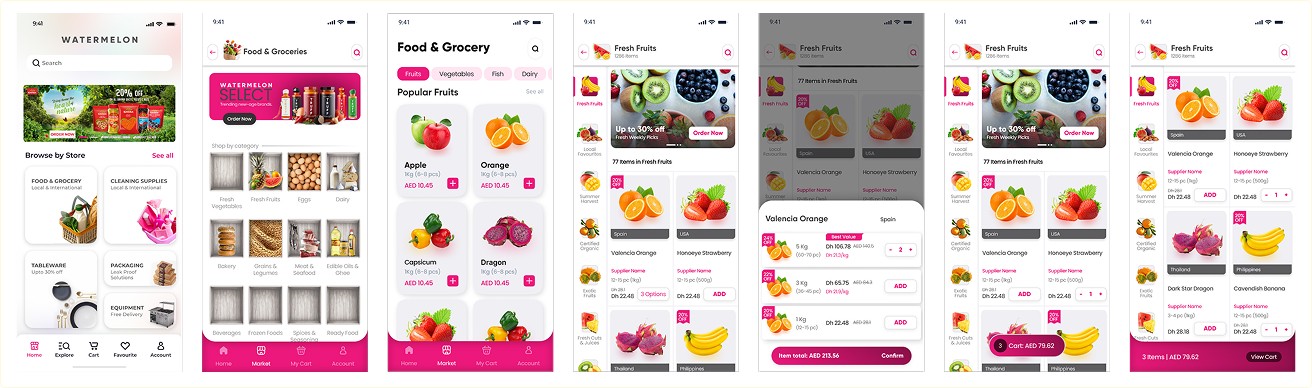
With the strategy, workflows, & systems defined, the interface became an execution layer — not the starting point.
With the strategy, workflows, & systems defined, the interface became an execution layer — not the starting point.
With the strategy, workflows, & systems defined, the interface became an execution layer — not the starting point.

the glow-up
the glow-up
Buyer App Screens &
Feature Showcase
Buyer App Screens &
Feature Showcase
Buyer App Screens &
Feature Showcase
Buyer App Screens &
Feature Showcase
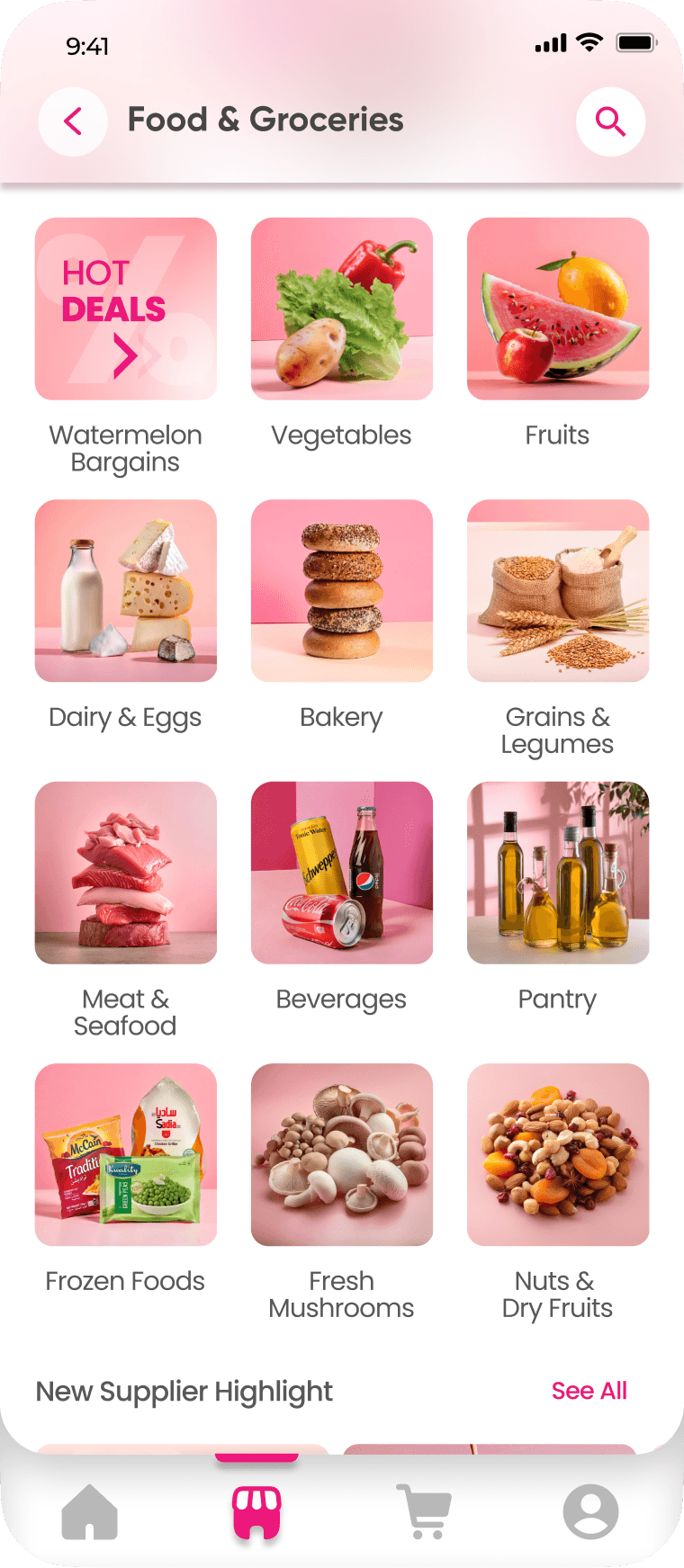
Dynamic Home screen
The platform immediately communicates scale, relevance, and value — making it clear why users should browse here instead of ordering offline.

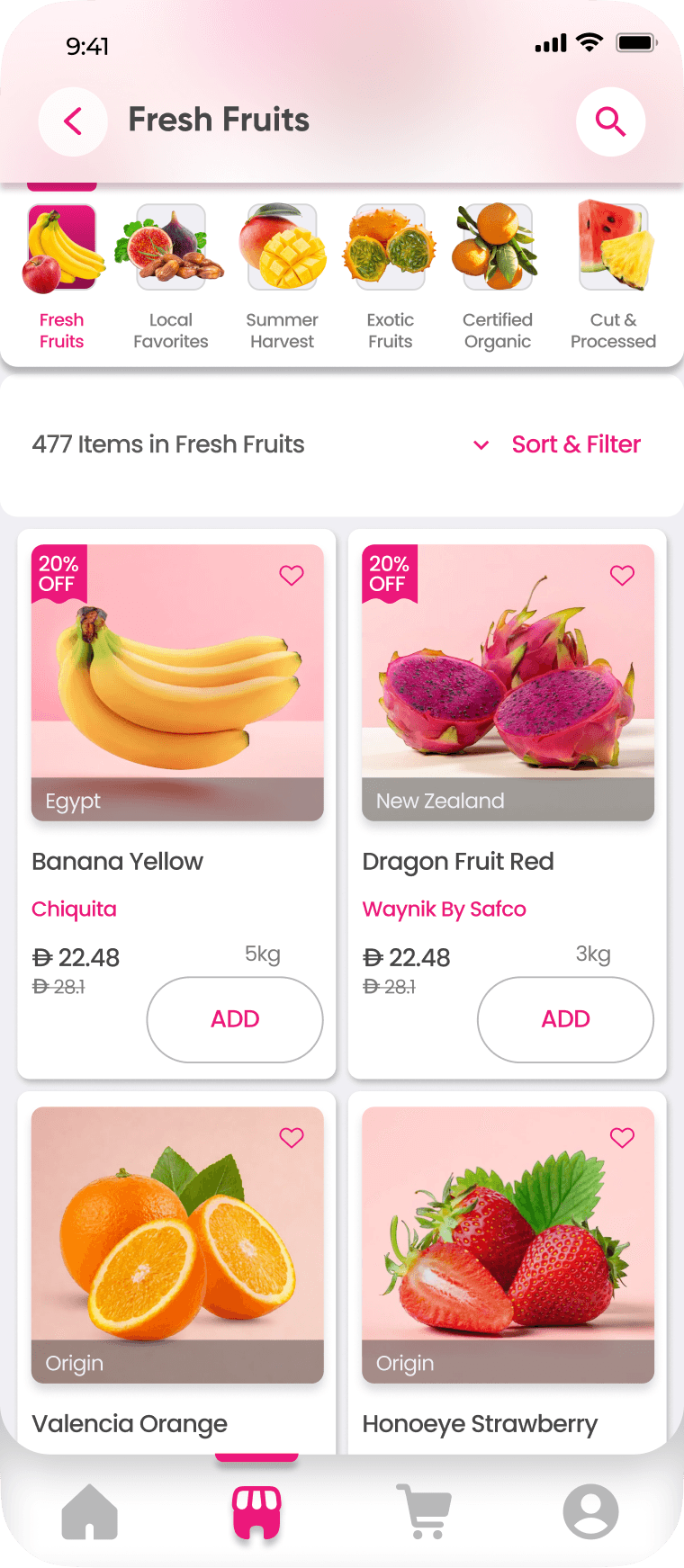
Product Discovery & Browsing Experience
Purpose: Increase exploration & browsing time - which leads to adding more items to cart.
How visual hierarchy, imagery, and structure improved product findability and encouraged deeper exploration.Split cart by suppliers
Break-up orders by suppliers with independent MOVs and delivery conditions
Supplier Micro-Stores
Support supplier-led buying & MOV optimisation
Turning suppliers into mini-stores helped buyers shop with intent, improved supplier visibility, and supported larger, repeat orders.
Finance
DashboardTrack limits, approvals, due dates, and settlements in real time.

Watermelon
CreditGives buyers the flexibility to purchase on credit with flexible payment terms.

Watermelon
Credit PaymentGives buyers the flexibility to make customised payments based on situations
The new visual language of F&B Commerce
The new visual language of F&B Commerce
The new visual language of F&B Commerce
The new visual language of F&B Commerce
Standardising 30,000+ SKUs into one coherent visual system — without a studio, a photographer, or a six-month backlog.
Standardising 30,000+ SKUs into one coherent visual system — without a studio, a photographer, or a six-month backlog.
Standardising 30,000+ SKUs into one coherent visual system — without a studio, a photographer, or a six-month backlog.
Standardising 30,000+ SKUs into one coherent visual system — without a studio, a photographer, or a six-month backlog.
Watermelon's catalogue spanned everything from fresh produce and meat to packaged goods and beverages - sourced from hundreds of suppliers, each with wildly inconsistent (or missing) product photography.
Rather than commission traditional photography at that scale, we built an AI image pipeline: a single studio-grade backdrop, lighting, and framing standard applied programmatically across every SKU, blended with a library of references sourced online.
Watermelon's catalogue spanned everything from fresh produce and meat to packaged goods and beverages - sourced from hundreds of suppliers, each with wildly inconsistent (or missing) product photography.
Rather than commission traditional photography at that scale, we built an AI image pipeline: a single studio-grade backdrop, lighting, and framing standard applied programmatically across every SKU, blended with a library of references sourced online.
Watermelon's catalogue spanned everything from fresh produce and meat to packaged goods and beverages - sourced from hundreds of suppliers, each with wildly inconsistent (or missing) product photography.
Rather than commission traditional photography at that scale, we built an AI image pipeline: a single studio-grade backdrop, lighting, and framing standard applied programmatically across every SKU, blended with a library of references sourced online.
Watermelon's catalogue spanned everything from fresh produce and meat to packaged goods and beverages - sourced from hundreds of suppliers, each with wildly inconsistent (or missing) product photography.
Rather than commission traditional photography at that scale, we built an AI image pipeline: a single studio-grade backdrop, lighting, and framing standard applied programmatically across every SKU, blended with a library of references sourced online.
The system was built to solve for three things at once:
The system was built to solve for three things at once:
The system was built to solve for three things at once:
Consistency at scale - one visual standard across 30,000+ SKUs, regardless of supplier photo quality
Speed to catalogue - new SKUs go live in a standardised format in hours, not weeks
Consistency at scale - one visual standard across 30,000+ SKUs, regardless of supplier photo quality
Speed to catalogue - new SKUs go live in a standardised format in hours, not weeks
Category-appropriate realism - AI-generated backdrops for packaged/dry goods, real photography retained where freshness and texture drive purchase decisions
Category-appropriate realism - AI-generated backdrops for packaged/dry goods, real photography retained where freshness and texture drive purchase decisions














The outcome
The outcome
The outcome
The outcome
From an Incomplete Catalogue to a System of Trust
From an Incomplete Catalogue to a System of Trust
From an Incomplete Catalogue to a System of Trust
Exploration before execution.
Exploration before execution.
Exploration before execution.
Exploration before execution.
Watermelon didn't need another interface - it needed an operating system. What started as an audit of why buyers were bypassing the platform became a full rebuild of discovery, payments, transaction logic, and visual identity across four connected surfaces: Buyer, Supplier, POS, and Back-End Admin.
The result is a marketplace that finally behaves like the businesses it serves - one where 45,000+ SKUs are discoverable in seconds, where suppliers are held to a single visual and operational standard, and where every transaction, credit line, and invoice lives inside Watermelon instead of leaking into offline workarounds.
Watermelon didn't need another interface - it needed an operating system. What started as an audit of why buyers were bypassing the platform became a full rebuild of discovery, payments, transaction logic, and visual identity across four connected surfaces: Buyer, Supplier, POS, and Back-End Admin.
The result is a marketplace that finally behaves like the businesses it serves - one where 45,000+ SKUs are discoverable in seconds, where suppliers are held to a single visual and operational standard, and where every transaction, credit line, and invoice lives inside Watermelon instead of leaking into offline workarounds.
Watermelon didn't need another interface - it needed an operating system. What started as an audit of why buyers were bypassing the platform became a full rebuild of discovery, payments, transaction logic, and visual identity across four connected surfaces: Buyer, Supplier, POS, and Back-End Admin.
The result is a marketplace that finally behaves like the businesses it serves - one where 45,000+ SKUs are discoverable in seconds, where suppliers are held to a single visual and operational standard, and where every transaction, credit line, and invoice lives inside Watermelon instead of leaking into offline workarounds.
Watermelon didn't need another interface - it needed an operating system. What started as an audit of why buyers were bypassing the platform became a full rebuild of discovery, payments, transaction logic, and visual identity across four connected surfaces: Buyer, Supplier, POS, and Back-End Admin.
The result is a marketplace that finally behaves like the businesses it serves - one where 45,000+ SKUs are discoverable in seconds, where suppliers are held to a single visual and operational standard, and where every transaction, credit line, and invoice lives inside Watermelon instead of leaking into offline workarounds.
4X
4X
4X
Increase in app session length
Increase in app session length
Increase in app session length
Increase in app session length
24%
24%
24%
Increase in avg. ticket value
Increase in avg. ticket value
Increase in avg. ticket value
Increase in avg. ticket value
60%
60%
60%
Increase Supplier Activity
Increase Supplier Activity
Increase Supplier Activity
Increase Supplier Activity
40%
40%
40%
reduction in manual admin work
reduction in manual admin work
reduction in manual admin work
reduction in manual admin work
2,900+
2,900+
2,900+
Restaurants
Restaurants
Restaurants
Restaurants
750+
750+
750+
Suppliers
Suppliers
Suppliers
Suppliers

WATERMELON WEB PLATFORM
WATERMELON WEB PLATFORM
WATERMELON WEB PLATFORM
Designing the Region's Most Holistic F&B Procurement Platform
Designing the Region's Most Holistic F&B Procurement Platform
Read More
Read More
Read More
Read More

